
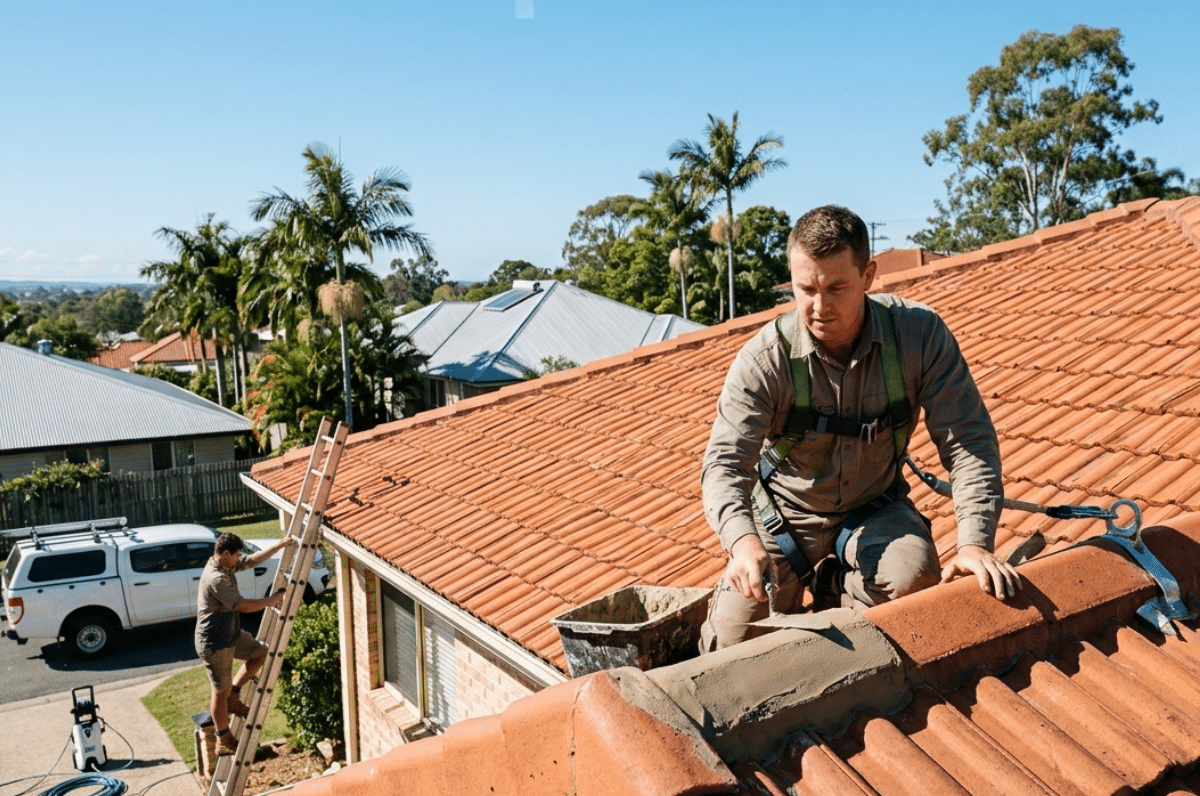
Is Winter the Best Time for Tile Roof Restoration in Brisbane?
If you have already worked out that your roof needs restoring, the next question is usually about timing. Do you book it now, wait for warmer weather, or hold off until the budget looks healthier next year?
Plenty of roofing websites answer that with “any time is a good time”, which is not much help to anyone. The truth is that season genuinely matters for a tile roof restoration in Brisbane, because coatings, pointing compounds and cleaning all behave differently depending on temperature, humidity and how much rain sits over the city in a given month.
This article gives you a direct answer, then explains the reasoning behind it: how Brisbane’s winter conditions affect the materials, how winter compares with summer and storm season, what happens to booking availability through the year, and how to tell whether your roof can safely wait at all.
Brisbane Tile Roof Restorations has worked exclusively on tile roofs in Queensland since 1981, so the seasonal patterns below come from decades of scheduling real jobs around real Brisbane weather.
The Short Answer: Why Brisbane Winter Suits Tile Roof Restoration
Yes. For most homes, winter is the best time of year to book a tile roof restoration in Brisbane.
Here is why, in brief:
- Stable, dry weather. June through August are among Brisbane’s driest months, with fewer rain days interrupting work.
- Comfortable working temperatures. Winter daytime temperatures typically sit in the low twenties, which is close to ideal for applying roof coatings. Summer surface temperatures on a dark tile roof can climb well past what coatings are designed to handle.
- Lower humidity. Drier air means faster, more even curing for both coatings and pointing compounds.
- Fewer weather delays. Jobs finish closer to the scheduled timeframe, which matters when your roof is partially opened up.
- Better availability. Book in winter and you are ahead of the spring rush rather than in the queue behind it.
- You are ready for storm season. A roof restored in July is fully cured and sealed before the first serious spring storm arrives.
The one qualification is that winter is not risk free. Brisbane can still get a wet week in June, and cold, damp mornings shorten the usable working day. A competent roofer plans around this rather than pretending it does not exist.
Everything below explains the reasoning in more detail, so you can judge the timing against your own roof rather than a general rule.
How Brisbane’s Winter Weather Affects Roof Coatings and Pointing
A tile roof restoration is not one job. It is a sequence of processes, and each one has its own relationship with the weather.
High pressure cleaning needs the roof to dry properly afterwards. Wash a roof in humid, overcast summer conditions and moisture can linger in porous concrete tiles for far longer than the surface suggests. Winter’s drier air pulls that moisture out more reliably, which matters because coating over a damp tile is one of the main causes of premature peeling.
Re-bedding and repointing involve cement mortar and flexible pointing compound, both of which cure through a chemical reaction rather than simple drying. Extreme heat causes mortar to cure too fast, which weakens it and can cause shrinkage cracking. Mild winter temperatures allow a slower, stronger cure.
Primer and coating application is the most weather sensitive stage. Most acrylic roof coatings specify a working temperature range, typically somewhere around 10 to 35 degrees ambient, and a surface that is neither too hot nor too cold. On a 34 degree Brisbane summer day, the surface temperature of a dark tile roof can easily exceed 60 degrees. Coating applied to a surface that hot flashes off before it can properly wet the tile and bond, which leads to poor adhesion and a shorter service life.
Winter avoids both extremes. Mornings may start too cool to begin coating immediately, but by mid morning the tiles reach a comfortable working temperature and stay there for most of the day.
The practical result is a coating that bonds properly, cures evenly and holds its colour and protective qualities for longer. That is the whole point of a restoration, so the conditions it is applied in are not a minor detail.
Winter vs Summer vs Storm Season: Comparing the Restoration Windows
Every season has trade-offs. Here is an honest comparison.
Winter (June to August)
- Advantages: driest months, mild temperatures, low humidity, reliable scheduling, best coating conditions, roof ready before storm season
- Disadvantages: shorter daylight hours, cold starts delay the first coat, occasional wet weeks still happen
- Best for: planned restorations where you have the luxury of choosing your timing
Spring (September to November)
- Advantages: long daylight hours, generally warm and workable early in the season
- Disadvantages: storm season begins, humidity climbs, demand spikes after the first big storm, lead times stretch out
- Best for: jobs booked before September, not after
Summer (December to February)
- Advantages: long working days, fast drying between showers
- Disadvantages: extreme roof surface temperatures, high humidity, frequent afternoon storms causing part-day losses, heat safety limits on crew hours
- Best for: urgent repairs rather than full restorations
Autumn (March to May)
- Advantages: cooling temperatures, humidity dropping, a genuinely good secondary window
- Disadvantages: tail end of storm season in March, competing demand from post-storm repair work
- Best for: a solid alternative if winter does not suit
If you rank these purely on material performance and schedule reliability, winter comes first and autumn a close second. Summer is workable but least favourable for full restorations, mainly because of surface temperature and the constant interruption of afternoon storms.
Drying Times, Humidity and Why Coating Conditions Matter
This is the technical heart of the timing question, so it is worth being specific.
A roof coating system is applied in layers: a sealer or primer that penetrates and binds the tile surface, then two coats of membrane. Each layer has to reach a certain state of cure before the next goes on. Rush it and you trap solvent or moisture between layers, which shows up months later as blistering, peeling or patchy fade.
Three variables control that timing:
- Ambient temperature. Cooler air slows curing. Very cold conditions can prevent an acrylic coating from forming a proper film at all, which is why work usually starts mid morning rather than at first light in winter.
- Relative humidity. High humidity slows the evaporation of water from a water based coating dramatically. A coat that would be touch dry in an hour at 45 percent humidity can take several times longer at 85 percent.
- Surface moisture. Dew, recent rain or moisture still held in porous tiles all undermine adhesion, regardless of how dry the air feels.
Brisbane winter mornings do bring heavy dew, and that is a real constraint. It is managed by starting the day with preparation and repair work, then moving to coating once the roof surface has dried and warmed. A crew that understands this simply sequences the day differently. A crew that does not will coat too early and you will find out about it in two years.
The upside is that once conditions are right, winter days offer long stretches of steady, low humidity conditions with no afternoon storm rolling in at three o’clock. That consistency is exactly what a coating system wants.
Booking Lead Times: What Happens to Availability After the First Big Storm
This is the part homeowners most often underestimate.
Brisbane’s roofing industry runs on a predictable annual cycle:
- June to August: steady demand, reasonable lead times, restorations booked and completed largely on schedule.
- September to October: demand begins climbing as people prepare for summer and notice problems.
- First major spring storm: the entire industry pivots. Emergency repairs, tarping, insurance work and storm damage assessments take priority over planned restorations, as they should.
- November to February: lead times stretch significantly. Planned restoration work is scheduled around emergency callouts and repeatedly interrupted by weather.
- March to May: the backlog gradually clears.
The consequence is straightforward. A restoration you could have booked in July with a comfortable lead time may push out considerably if you wait until November, and the work itself will be interrupted more often once it starts.
There is a second cost to waiting that has nothing to do with scheduling. Every month a deteriorating roof stays deteriorated is another month of water getting into places it should not. A restoration deferred from winter to autumn can quietly turn into a restoration plus timber repairs plus a ceiling replacement.
If you know your roof needs work, booking during the winter window buys you both a better price position and a better outcome.
Signs Your Roof Cannot Wait Until Next Season
Timing advice assumes you have a choice. Some roofs do not give you one. Arrange an inspection promptly, regardless of season, if you see any of the following:
- Active leaks. Water dripping inside during rain means the roof has already failed and is causing damage right now.
- Spreading ceiling stains. If a stain grows after each rain event, water is still entering.
- Missing or dislodged ridge caps. These are a safety hazard as well as a direct water entry point.
- Multiple broken or slipped tiles. Each one breaks the drainage path for everything above it.
- Daylight visible in the roof cavity. A direct opening to the outside is never a monitor-and-wait situation.
- Sagging roofline. This points to structural stress and gets worse, and more expensive, quickly.
- Sarking that is torn or perished. The last line of defence is gone.
- Widespread mortar failure. Grit in the gutters after every rain means the ridges are actively breaking down.
In these cases the right approach is often staged. Urgent repairs are carried out immediately to stop water ingress, and the full restoration is scheduled for the next suitable weather window. That way you are not gambling on the weather to protect your home, and you are not rushing a coating system into unsuitable conditions either.
The wrong approach is waiting for the perfect season while water works through your roof timbers.
What a Winter Tile Roof Restoration Involves From Quote to Completion
Knowing the sequence helps you plan around it. A typical tile roof restoration runs like this.
1. Inspection and quote. Safe roof access, a full assessment of tiles, ridges, valleys, flashings and the roof cavity, with photographs. You receive a clear written quote based on what the roof actually needs, with no hidden extras.
2. Scheduling. A start date is set with a realistic weather buffer built in. In winter that buffer is smaller than in summer, which is part of the appeal.
3. Repairs. Cracked, chipped and slipped tiles are replaced. Valleys are cleared and assessed. Any flashing or penetration issues are addressed before anything else happens.
4. High pressure cleaning. Moss, lichen, dirt and failed old coating are removed. Gutters and downpipes are protected and cleared of debris afterwards.
5. Re-bedding and repointing. Failed mortar bedding is replaced where needed, and all ridge caps are re-pointed with a flexible pointing compound that moves with the roof rather than cracking against it.
6. Sealing and coating. A primer or sealer is applied to bind the tile surface, followed by two coats of protective membrane in your chosen colour.
7. Clean up and final inspection. The site is cleared, gutters flushed, and the finished work walked through with you.
Most restorations take a handful of days depending on roof size, pitch, access and the extent of repairs. Winter’s stable conditions mean that estimate holds up more reliably than the same job quoted in December. You do not need to be home for the work, provided safe roof access is available.
Restoration or Replacement: Making the Call Before You Book
Before booking any season, it is worth confirming that restoration is the right answer for your roof at all.
Restoration is usually the better option when:
- The roof structure, battens and rafters are sound
- Tiles are intact or only isolated tiles are damaged
- The main issues are surface deterioration, failed pointing and worn coating
- The roof is a standard concrete or terracotta tile profile with replacement tiles available
- You want to extend the roof’s life and appearance at a fraction of replacement cost
Replacement starts to make sense when:
- Tiles are widely broken, delaminating or crumbling under foot
- Structural timbers show significant rot or termite damage
- The tile profile is obsolete and matching replacements cannot be sourced
- The roof has been repeatedly patched over many years with diminishing returns
- You are re-roofing as part of a larger renovation anyway
In our experience, most Brisbane tile roofs that homeowners assume need replacing are actually good candidates for restoration. Concrete and terracotta tiles are durable materials. It is usually the pointing and the protective coating that have worn out, not the tiles themselves, and both of those are exactly what a restoration renews.
An honest inspection settles the question quickly. Any roofer who recommends replacement without showing you evidence of structural failure is worth a second opinion.
Preparing Your Home for Roof Restoration Work in Cooler Months
A little preparation makes the job smoother for everyone.
Around the house:
- Clear vehicles, bins and outdoor furniture from beside the house to give safe ladder and access room
- Move or cover pot plants and delicate garden beds along the roof perimeter
- Close windows and skylights on cleaning and coating days
- Retract or cover shade sails, awnings and pergola covers near the work area
- Secure gates so pets cannot wander into the work zone
Practical winter specifics:
- Expect work to start mid morning rather than at dawn while dew clears
- Bring washing in on cleaning days, as high pressure work throws spray a fair distance
- Keep pets indoors during cleaning and coating, since the noise carries and wet coating should not be walked through
- Disconnect rainwater tanks before cleaning and coating, and reconnect after a couple of decent rain events have flushed the roof
Communication:
- Let neighbours know, particularly if access near a shared boundary is needed
- Agree with your roofer on how you will be updated if weather shifts the schedule
- Ask for photographs of hidden work such as re-bedding, since you will not see it once the coating is on
None of this is onerous. Fifteen minutes of preparation the evening before removes most of the friction from the week.
The Verdict on Timing
Winter is the best window for a tile roof restoration in Brisbane, and it is not a close call. Drier air, mild temperatures and stable conditions produce better adhesion and a stronger cure for both coatings and pointing. Schedules hold. Lead times are reasonable. And the work is finished and fully cured well before spring storms arrive to test it.
Autumn is a strong second choice. Summer and peak storm season are workable when necessary, but they involve more compromise, more interruption and longer waits.
The exception overrides all of it: if your roof is actively leaking, missing ridge caps, showing daylight or sagging, the best time to act is now. Urgent repairs first, full restoration at the next suitable window.
If you are weighing up when to restore your tile roof, the most useful next step is a proper inspection so you know exactly what you are dealing with before you commit to a date.
Brisbane Tile Roof Restorations has specialised in tile roofs across Queensland since 1981. We are fully licensed (BSA 736 636 / 736 635), trusted by BUILD and Liberty Homes, and we quote honestly on what your roof genuinely needs.
Call 0413 432 014 or request your free quote to secure a winter booking for your tile roof restoration in Brisbane.


About Post Author
