Tile Roof Repairs Brisbane: 6 Winter Warning Signs to Check
Winter in Brisbane has a way of finding every weakness in a tile roof. The heat backs off, the mornings turn damp, and those long, steady bands of rain sit over the city for days instead of blowing through in twenty minutes. That change in weather is exactly why so many homeowners start noticing problems between June and August that were invisible all summer.
The good news is that most tile roof faults announce themselves well before they become expensive. A faint stain on a ceiling, a chip in a tile, a bit of grey grit in the gutter after rain. These are early warnings, not emergencies, and catching them now is the difference between a morning of repointing and a full ceiling replacement.
This guide walks through six warning signs worth checking this winter, how urgent each one is, and what a professional inspection actually involves. Brisbane Tile Roof Restorations has worked exclusively on tile roofs across Queensland since 1981, so everything below comes from what we see on real Brisbane roofs, not a generic checklist.
Why Brisbane Winters Expose Tile Roof Problems You Never Noticed in Summer
Brisbane’s subtropical climate is hard on concrete and terracotta tiles, but it is hard on them in a slow, cumulative way. Summer brings intense UV, high heat and sudden storms. Every hot day expands the tiles and the mortar bedding underneath them, and every cool night contracts them again. Repeated thousands of times, that movement opens hairline cracks in mortar and works ridge caps loose by fractions of a millimetre.
Summer rain often hides the result. A short, violent storm dumps water and moves on, and the roof dries out within the hour before moisture has time to travel through the roof cavity and show up on a ceiling.
Winter behaves differently. Rain arrives softer but lingers, humidity stays high, and roofs stay wet for longer stretches. Water gets time to find the gap, sit in it, and track along a batten to a plasterboard joint. Cooler air also means more condensation in poorly ventilated roof spaces, which encourages mould and timber decay.
So a “new” winter leak is rarely new. It is usually a fault that developed months or years ago and has finally been given the conditions to reveal itself. That is why tile roof repairs in Brisbane spike in the cooler months, and why a winter inspection often uncovers wear that a summer glance would miss.
Warning Sign 1: Water Stains, Bubbling Paint or Musty Smells Inside
The clearest signals often appear inside the house rather than on the roof.
Look for:
- Yellow, brown or rust coloured rings on ceilings and cornices
- Paint that bubbles, blisters or flakes in patches rather than evenly
- Plasterboard that feels soft, sags slightly or shows a hairline seam opening up
- A damp, earthy or musty smell in bedrooms, hallways or a walk-in robe
- Dark spotting around ceiling vents, downlights or manhole edges
A useful tip: mark the outer edge of any stain with a pencil and date it. If the mark spreads after the next decent rain, water is still getting in and the problem is active. If it stays put, it may be an old, resolved leak, though it should still be checked.
Do not assume the leak sits directly above the stain. Water entering at a cracked ridge cap can run several metres along a rafter or a sarking fold before it drops. This is one of the main reasons DIY diagnosis so often lands in the wrong spot, and why tracing the actual entry point takes roof access and experience.
Musty smells without a visible stain deserve attention too. That usually means moisture is being absorbed by insulation and evaporating slowly, which can lead to mould growth long before a stain becomes obvious.
Warning Sign 2: Cracked, Chipped or Slipped Roof Tiles
Individual tiles fail for predictable reasons: hail, falling branches, foot traffic from a solar or antenna installer, or simple age. Concrete tiles become more porous and brittle over decades, while terracotta tiles are harder but crack cleanly under impact.
You can check a lot of this safely from ground level with binoculars or the zoom on your phone camera. Walk the full perimeter of the house and look for:
- Tiles sitting lower or higher than the ones around them
- Visible cracks running across the face of a tile
- Chipped corners, especially along the edges of the roof and around valleys
- Gaps where a tile has slipped out of its overlap
- Fragments of tile or mortar sitting in gutters and downpipe outlets
Slipped tiles matter more than most homeowners expect. Tile roofs are designed to shed water through overlap, not to be waterproof in themselves. When one tile shifts, it breaks the drainage path for every tile above it and funnels water straight onto the sarking or the timber below.
A single cracked tile in an open area is usually a quick fix. Several cracked tiles across different parts of the roof is a different story and generally points to age-related deterioration across the whole surface, which shifts the conversation towards restoration.
Please resist the urge to climb up and replace tiles yourself. Tiles are brittle, roof pitches in Brisbane are often steeper than they look from the driveway, and walking incorrectly on a tile roof commonly creates more cracks than it fixes.
Warning Sign 3: Crumbling Mortar and Lifting Ridge Caps
If there is one fault we see more than any other, it is failed pointing along the ridges and hips.
Ridge caps are held in place by a bed of cement mortar and sealed with a pointing compound. Traditional cement pointing is rigid, and rigid materials do not cope well with decades of thermal movement. Eventually they craze, crumble and let go.
Signs to watch for:
- Grey or sandy grit collecting in gutters and on paths after rain
- Visible gaps or missing sections along the ridge line
- Ridge caps that look slightly rotated, lifted or out of alignment
- Mortar that looks chalky, pitted or discoloured compared with the rest of the roof
- Loose pieces of mortar in the garden beds below the roof edge
Ridge lines are the highest point of the roof and take the full force of wind driven rain, so failing pointing here is a direct path for water into the roof cavity. It is also a safety issue. A ridge cap that has lost its bedding can dislodge in strong winds.
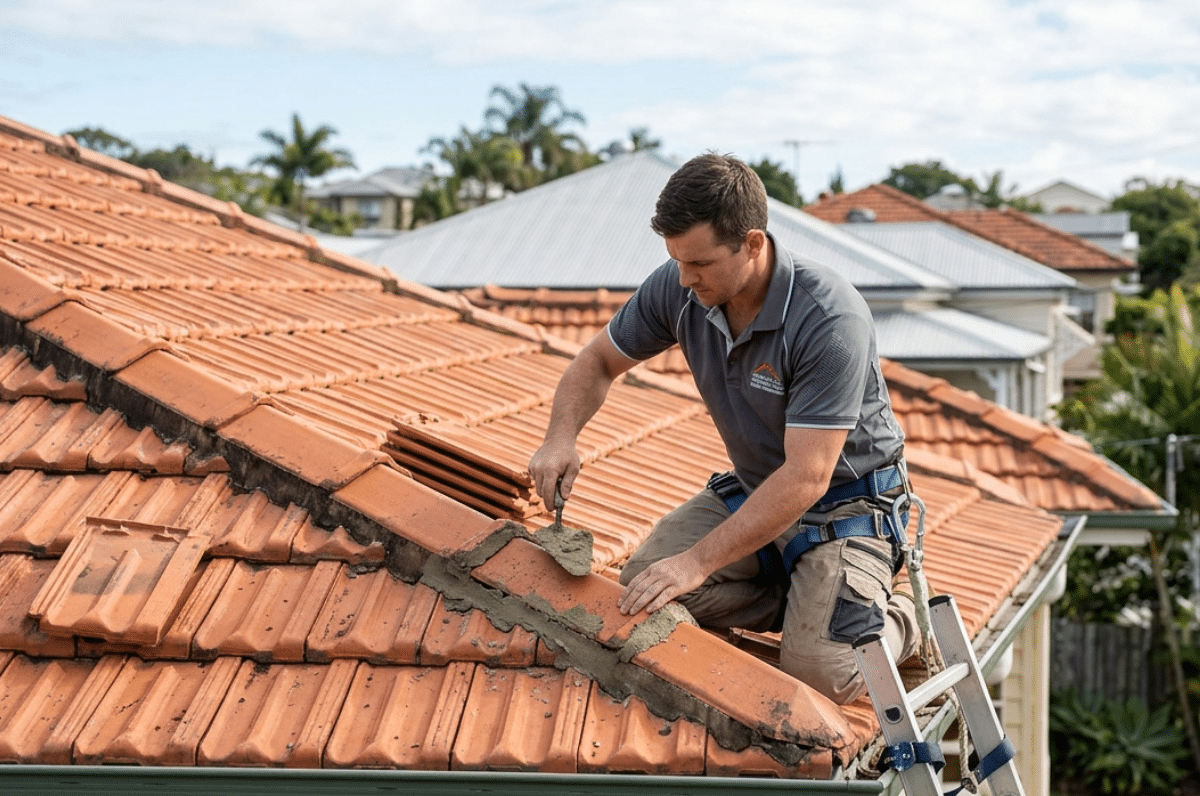
The fix is roof repointing, which involves removing the failed material and re-pointing with a flexible pointing compound that moves with the roof rather than cracking against it. Where the bedding underneath has also broken down, the ridge caps are re-bedded first. Repointing is one of the most cost-effective tile roof repairs available in Brisbane, and it typically adds years to the life of an otherwise sound roof.
Warning Sign 4: Blocked Valleys, Gutters and Overflow During Rain
Valleys are the metal channels where two roof planes meet, and they carry an enormous volume of water. They are also natural collection points for leaf litter, especially under gum trees and jacarandas.
The best time to assess this sign is during rain. From a covered spot, watch how water behaves:
- Water spilling over the front edge of the gutter instead of running to a downpipe
- Water running down an external wall or pooling against the fascia
- A waterfall effect from one section of roof onto another
- Downpipes that stay silent while the gutter fills
Blocked valleys are particularly serious. When debris dams a valley, water backs up sideways under the tiles, bypasses the overlap entirely and enters the roof space. Long-term, sitting debris also holds moisture against the valley iron and rusts it through.
Practical maintenance tips:
- Clear gutters and valleys at least twice a year, more often under heavy tree cover
- Trim branches that overhang the roof line
- Check that downpipes discharge properly and are not blocked at ground level
- Consider valley or gutter guards if leaf load is constant
If you are seeing rust staining, perforation or water marks along a valley, that is beyond routine cleaning and needs proper assessment.
Warning Sign 5: Moss, Lichen and Persistent Damp Patches on the Tiles
South facing roof planes and shaded sections in Brisbane hold moisture through winter, and moss, lichen and algae take full advantage.
Growth on tiles is not just cosmetic. It matters because:
- Moss holds water directly against the tile surface, keeping it saturated
- Roots work into cracks and porous concrete and widen them over time
- Growth traps debris and slows drainage across the tile
- Heavy accumulation adds weight and can block the water channels in the tile profile
Lichen in particular is stubborn. It bonds tightly to the tile and is a fair indication that the protective surface coating has worn away, leaving the concrete exposed and absorbent. A roof that stays visibly wet for hours after everything around it has dried is telling you the same thing.
Avoid attacking growth with a high pressure washer on a whim. Excessive pressure strips what is left of the surface coating, drives water under the tile laps and can crack older, brittle tiles. Proper treatment involves controlled cleaning followed by a protective coating, which is exactly what a full roof restoration is designed to deliver.
Widespread moss and lichen usually means a roof has passed the point where spot repairs alone are the right answer.
Warning Sign 6: Sagging Rooflines or Daylight Visible in the Roof Cavity
This is the most serious category, and thankfully the least common.
Stand across the street and sight along the ridge line and the eaves. They should read as straight lines. A visible dip, bow or wave suggests the structure underneath is under stress, which can be caused by:
- Long-term water damage weakening rafters or battens
- Timber decay or termite activity
- Additional load such as accumulated debris or added roof equipment
- Original construction issues that have progressed
The other check is from inside. On a bright day, put your head through the manhole (feet on the ladder, nothing more) and let your eyes adjust. Points of daylight, other than deliberate vents, mean there are direct openings to the outside. Also look for damp or blackened timber, sagging insulation, rusted valley iron and any drip marks on the underside of tiles.
Daylight and sagging both mean stop investigating and call a professional. These are not conditions to monitor over another few months of winter rain. Structural issues get more expensive at a much steeper rate than surface issues.
Which Warning Signs Need Urgent Tile Roof Repairs and Which Can Wait
Not every fault demands a same-week booking. Here is a practical way to triage what you have found.
Call immediately
- Sagging roofline or bowed ridge
- Daylight visible in the roof cavity
- Active dripping into the house during rain
- Multiple dislodged or missing tiles
- A ridge cap that has come loose or fallen
Book within a few weeks
- Water stains that spread after rain
- Cracked or slipped individual tiles
- Crumbling mortar and grit in the gutters
- Valley blockages or gutter overflow
- Musty smells with no visible source
Monitor and address at the next service
- Light moss or algae on shaded sections
- Minor surface fading or chalking of the tiles
- Small chips that have not broken through the tile
- Old, dry stains that have not changed in size
One caution on the third group. “Can wait” means weeks or a couple of months, not another year. Brisbane’s storm season starts building again in spring, and a minor fault carried into November has a habit of becoming an emergency during the first serious downpour.
If you are unsure which column your issue belongs in, that uncertainty is itself a reason to have someone look. An inspection costs far less than a wrong guess.
What a Professional Tile Roof Inspection in Brisbane Actually Involves
A proper inspection is a methodical process, not a quick look from the driveway.
Here is what a thorough tile roof inspection covers:
- Safe roof access. Correct ladder setup and safe movement across the tiles, without adding to the damage.
- Full tile assessment. Every plane checked for cracked, chipped, slipped or previously repaired tiles, including areas not visible from the ground.
- Ridge and hip inspection. Every ridge cap checked individually for movement, and the condition of both the bedding and the pointing assessed.
- Valley and drainage check. Valleys cleared enough to assess the metal underneath, plus gutters, downpipes and flashing points.
- Penetration checks. Around vents, flues, skylights, solar mounts and antenna fixings, which are common entry points.
- Roof cavity review. Looking from inside for damp timber, water tracking, sarking condition and insulation damage.
- Photographic record. So you can see what we see, rather than taking it on faith.
At the end of it you should receive a clear explanation in plain language of what was found, which items are urgent, which are optional, and an accurate written quote with no hidden surprises. Anyone unwilling to show you evidence of the problem they are quoting on is worth a second opinion.
Repair, Repoint or Restore: Choosing the Right Fix for Your Roof
Once the inspection is done, the recommendation generally falls into one of three categories.
Targeted repairs suit roofs in good overall condition with isolated faults. Think a handful of cracked tiles, one failed valley, or a leak around a single penetration. The tiles themselves still have plenty of service life left, and there is no sense spending money on the rest of the roof. This is the lowest cost option and often takes less than a day.
Roof repointing is the answer when the tiles are sound but the ridge mortar has failed. Because ridge lines are where most tile roof leaks begin, repointing solves a disproportionate share of problems for a moderate cost. Flexible pointing compounds handle Brisbane’s thermal movement far better than old cement, and the finished ridge line noticeably lifts the appearance of the house as well.
Full roof restoration makes sense when wear is widespread: multiple cracked tiles across several planes, failed pointing throughout, heavy moss and lichen, and a tile surface that has lost its coating. Restoration typically involves repairs, high pressure cleaning, re-bedding and repointing of all ridge caps, then sealing and coating the tiles. It is a bigger job, but it is almost always more cost-effective than a full roof replacement when the underlying structure is sound, and it resets the clock on the roof’s protective surface.
Cost varies with roof size, pitch, access, tile condition and the extent of work required, which is why any quote given before an inspection is guesswork. What matters is that the recommendation matches what the roof actually needs. A good roofer will tell you when a repair will do, not push a restoration onto a roof that does not need one.
Protect Your Roof Before the Next Downpour
Winter does not create most tile roof problems. It reveals them. Water stains inside, cracked or slipped tiles, crumbling mortar, blocked valleys, moss growth and any sign of sagging are all your roof telling you something before it becomes a much bigger bill.
Work through the six signs above this weekend. Most of the checks take fifteen minutes from ground level and from inside the roof cavity, and they will give you a genuine sense of whether you are looking at a quick repair, a repointing job or something more substantial.
If anything on the list gave you pause, have it assessed properly rather than waiting to see what spring storms do with it.
Brisbane Tile Roof Restorations has worked exclusively on tile roofs since 1981, is fully licensed (BSA 736 636 / 736 635), and is trusted by BUILD and Liberty Homes. We inspect thoroughly, explain what we find in plain terms, and quote honestly on what your roof genuinely needs.
Call 0413 432 014 or request your free quote today for professional tile roof repairs in Brisbane.


About Post Author
